

Are you struggling to pick the right alloy for your next public art project?
Nothing ruins a stunning piece faster than rust, pitting, and environmental corrosion.
When comparing 316L vs 304 stainless steel for outdoor sculptures, making the wrong choice can mean costly repairs—or seeing your hard work degrade before the public’s eyes.
One offers great structural value. The other provides unmatched marine-grade durability.
In this guide, you’ll learn the critical differences in corrosion resistance, longevity, and cost so you can choose the exact material your artwork needs to stand the test of time.
Let’s dive in.
Chemical Breakdown: 316L vs 304 Stainless Steel
Choosing the right alloy dictates whether an outdoor sculpture survives decades unblemished or succumbs to premature degradation. In our metal sculpture fabrication workshop, we analyze base metallurgy long before cutting the first sheet. Both 304 and 316L belong to the austenitic stainless steel family, yet their chemical compositions yield vastly different field performance under outdoor atmospheric stress.
Key Alloy Differences: Chromium, Nickel, and Molybdenum
The core distinction between these two grades lies in elemental composition, specifically the presence of molybdenum.
Chemical Element304 Grade (Standard)316L Grade (Marine/Low Carbon)Primary Functional Role in SculpturesChromium (Cr)18.0% – 20.0%16.0% – 18.0%Forms the passive chromium oxide protective filmNickel (Ni)8.0% – 10.5%10.0% – 14.0%Stabilizes austenite structure, boosts ductilityMolybdenum (Mo)None (trace only)2.0% – 3.0%Prevents chloride pitting and crevice corrosionCarbon (C)≤ 0.08%≤ 0.03%Dictates susceptibility to weld sensitization
- Chromium provides the baseline self-healing oxide film required for basic outdoor exposure.
- Nickel enhances structural ductility, helping sculptors execute deep cold-forming, hammering, and rolling.
- Molybdenum is the critical upgrade in 316L: a 2% to 3% addition that shields the alloy against salt spray, marine air, and industrial airborne chlorides.
Why the “L” Matters: Carbon Reduction and Intergranular Corrosion
The suffix “L” stands for low carbon content. In 304, standard carbon levels can reach up to 0.08%, whereas 316L caps carbon at 0.03%.
When TIG welding large sculpture assemblies, excessive heat drives carbon to bind with chromium at grain boundaries. This reaction, known as carbide precipitation, starves adjacent zones of protective chromium:
- Sensitization: Leaves heat-affected zones (HAZ) along weld seams defenseless against atmospheric moisture.
- Intergranular Corrosion: Destroys structural integrity quietly from within the metal grain structure.
- The 316L Advantage: Ultra-low carbon levels prevent chromium carbide formation during welding. Large-scale public art fabricated with 316L maintains continuous corrosion resistance through weld joints without requiring post-weld solution annealing.
Pitting Resistance Equivalent Number (PREN) Explained for Sculptors
The Pitting Resistance Equivalent Number (PREN) is a standardized mathematical metric used to quantify an alloy’s resistance to localized pitting corrosion:
PREN = %Cr + 3.3(%Mo) + 16(%N)
- Grade 304 PREN Range: 18.0 – 20.0
- Grade 316L PREN Range: 23.0 – 25.0
A higher PREN directly correlates to survival rates in aggressive exterior environments. While 304 performs reliably in sheltered inland parks, its lower PREN leaves it vulnerable to localized micro-pitting whenever moisture and chlorides sit on unwashed metal surfaces. The elevated PREN of 316L provides the safety margin necessary to preserve fine surface finishes across decades of unmonitored outdoor display.
Corrosion Resistance in Outdoor Sculptures: 316L vs 304 Stainless Steel
Selecting between alloys comes down to where the piece will stand. When evaluating 316L vs 304 stainless steel for outdoor sculptures, local atmospheric chemistry dictates whether your artwork stays pristine or develops unsightly surface defects over time.
Urban and Inland Exposure: 304 Performance
For dry, rural, or typical inland urban settings, 304 austenitic stainless steel is our standard shop choice. It forms a resilient chromium oxide film that repels moisture and everyday air exposure.
- Where it excels: Inland parks, municipal plazas, and private courtyards away from highway spray and ocean winds.
- Practical behavior: As long as rain naturally washes the metal, 304 resists uniform oxidation. We regularly fabricate steel garden sculptures from 304 for these inland microclimates with zero long-term degradation.
- The caveat: Sheltered areas under overhangs or intricate crevices can trap grime, requiring periodic rinsing to avoid localized discoloration.
Coastal and High-Salinity Zones: Preventing Tea-Staining with 316L
Salt air destroys ordinary alloys. If an installation sits within five miles of a coastline or near roads heavily salted in winter, airborne chlorides quickly breach the passive layer of 304.
- Tea-staining stainless steel: Chlorides produce a cosmetic reddish-brown surface discoloration called tea staining. While structurally sound at first, it ruins the visual intent of public art fabrication.
- Pitting corrosion: Left unchecked, salt traps in micro-crevices, triggering deep pitting that permanently mars smooth finishes.
- The 316L defense: The addition of 2% to 3% molybdenum in 316L marine grade stainless steel forms a chemical shield against chlorides, effectively stopping tea-staining and crevice corrosion before they start.
Industrial Zones and Acid Rain Resistance
Industrial environments introduce airborne sulfur dioxide, nitrogen oxides, and acidic particulate fallout that accelerate chemical breakdown.
Environmental Factor304 Stainless Steel316L Stainless SteelInland / Low PollutionExcellent; stable with routine rain washingSuperior; often exceeds requirementsMarine Air (< 5 miles from coast)Poor; prone to pitting and brown tea-stainingOutstanding; high chloride attack resistanceAcid Rain & Heavy SmogModerate; susceptible to localized spot attackHigh; resists acidic sulfur depositionDe-icing Salt ExposureLow; requires frequent fresh water washdownsHigh; holds up against ground spray
For heavy industrial corridors and coastal installations, we always rely on 316L. The chemical stability ensures the outdoor sculpture holds its intended aesthetic without requiring aggressive, continuous chemical cleanings.
Fabrication and Workability for Sculptors
When we shape metal sculpture in the shop, the practical differences between 316L vs 304 stainless steel for outdoor sculptures quickly show up at the workbench. Both are austenitic stainless steel grades, but their specific alloy mixes change how they behave under the torch, inside the slip roll, and beneath the polishing wheel. While some public monuments rely on a large bronze sculpture for traditional casting weight, modern structural commissions require precise mastery over these two stainless alloys during fabrication.
Weldability: Managing Carbide Precipitation and Heat-Affected Zones
Welding thick plate or thin sheet demands tight temperature control to prevent future corrosion at the seams.
- Carbide Precipitation: Standard 304 contains up to 0.08% carbon. During TIG welding, sustained heat between 800°F and 1500°F (425°C to 815°C) causes carbon to bind with chromium, depleting corrosion resistance along the heat-affected zone (HAZ).
- The “L” Advantage: 316L caps carbon at 0.03%. This ultra-low carbon level stops chromium carbide formation entirely, allowing full-penetration structural welds on heavy-gauge artwork without requiring post-weld solution annealing.
- Filler Wire Selection: We use ER316L filler wire for 316L stock to match alloy chemistry and maintain corrosion resistance across every weld bead.
Forming and Bending: Ductility and Work-Hardening Rates
Both grades offer excellent elongation for compound curves, rolled shells, and hand-hammered forms, but their work-hardening rates differ slightly:
Forming Characteristic304 Stainless Steel316L Stainless SteelWork-Hardening RateHigher (stiffens faster under cold work)Slightly lower and more progressiveDuctility (Elongation)~40–50% in annealed state~40–50% with higher malleabilityBending ResistanceRequires standard shop tonnageRequires roughly 5–10% more brake tonnageSpringbackPronounced; needs deliberate over-bendingPredictable recovery during multi-radius rolling
Because 316L contains 2% to 3% molybdenum and extra nickel, it feels slightly “stickier” during machining, yet it draws exceptionally well over custom forming dies without sudden edge tearing.
Grinding and Surface Finishing: Mirror Polish vs. Satin Brushed
Achieving an outdoor-ready surface comes down to controlling the surface roughness Ra value:
- Satin Brushed Finishes (No. 4): Produced using sequential 120- to 240-grit ceramic abrasives. While straightforward to apply on both alloys, 304 brushed surfaces retain microscopic crevices that can trap atmospheric chlorides outdoors.
- Mirror Finish (No. 8): Involves progressive sanding up to 2000-grit followed by cotton mops and cut-and-color compounds. 316L takes slightly longer to level because molybdenum toughens the metal matrix, but it yields a deep, distortion-free reflection that naturally sheds water, dirt, and airborne contaminants far better than directional grain finishes.
Cost Analysis and Long-Term Value: 316L vs 304 Stainless Steel for Outdoor Sculptures
When we budget a public art commission or private installation, metal selection defines both immediate production costs and multi-decade upkeep. Weighing 316L vs 304 stainless steel for outdoor sculptures is not just about upfront sheet prices—it is an investment equation balancing material premiums, shop labor, and environmental durability.
Raw Material Price Gap: Evaluating Initial Stock and Plate Costs
The initial price difference between 304 and 316L comes down to alloying elements, specifically nickel and molybdenum.
- Base Metal Premium: 316L raw plate, tube, and bar stock typically runs 25% to 40% higher in price than standard 304.
- Molybdenum Surcharge: The addition of 2% to 3% molybdenum in 316L directly tracks global alloy surcharges, making plate procurement more sensitive to market shifts.
- Structural Framing vs Skin: For large-scale outdoor sculptures, material costs scale rapidly. When estimating structural frameworks alongside outer cladding, fabricators often calculate overall metal budgets much like commissioners who understand the cost of bronze before you invest in heavy casting alloys.
MetricGrade 304Grade 316LAverage Raw Material CostBaseline+25% to +40%Molybdenum Content0%2.0% – 3.0%Alloy Surcharge VolatilityModerateHigherBest Budget FitInland, protected sitesCoastal, marine, industrial zones
Labor and Fabrication Cost Variables Between Alloys
While 316L carries a material premium, fabrication labor between the two austenitic grades remains relatively comparable, with a few critical shop differences:
- Welding Consumables: TIG and MIG welding 316L requires ER316L filler wire, which costs roughly 20% to 30% more than standard ER308L wire used for 304.
- Tool Wear and Machining: 316L work-hardens slightly faster during aggressive spinning, rolling, or hydroforming. This adds modest tooling wear and abrasive disc consumption during seam blending.
- Finishing Labor: Achieving a high-uniformity satin grain or a mirror finish demands equal abrasive grit sequences on both alloys. Labor hours for polishing remain practically identical.
Lifecycle Maintenance and Repair Expenses Over Decades
The true financial divergence shows up 5 to 15 years post-installation. A cheaper initial build can quickly turn into a high-maintenance liability if deployed in the wrong environment.
- Refurbishment Cycles: Using 304 in coastal salt air or heavy smog areas leads to tea staining and micro-pitting. Removing embedded rust requires repeated chemical washing, on-site mechanical repolishing, and repassivation, costing thousands per maintenance cycle.
- Zero-Intervention Longevity: Grade 316L resists pitting corrosion without continuous chemical intervention. The extra 30% spent on raw plate stock during fabrication easily offsets the cost of a single mobile rigging and refinishing crew down the road.
- Public Art Liability: Municipal and institutional clients frequently require a 25- to 50-year structural life with minimal surface degradation. Selecting 316L protects against warranty disputes, insurance claims, and premature deaccessioning caused by atmospheric decay.
Selecting the Right Grade for Your Sculpture Site
Choosing between 316L vs 304 stainless steel for outdoor sculptures comes down to local environment, exposure levels, and long-term maintenance budgets. We always evaluate the installation site before ordering plate stock to ensure the material matches its real-world conditions.
When 304 Stainless Steel Is the Practical Choice
Grade 304 is the workhorse alloy for outdoor metal art, provided the installation stays clear of severe chemical and chloride exposure:
- Inland and rural installations: Works reliably in parks, corporate campuses, and residential courtyards located miles away from saltwater bodies.
- Sheltered outdoor placements: Performs exceptionally well under covered pavilions, building overhangs, and porticos where rain does not trap dirt against unwashed metal surfaces.
- Budget-conscious public art: Keeps material costs manageable when fabricating large, monumental works that sit in standard urban parks with routine groundskeeping.
If you are looking to commission a beautiful stainless steel sculpture for a typical urban landscape or inland garden, 304 delivers solid durability without unnecessary alloy premiums.
When 316L Stainless Steel Is an Absolute Requirement
We treat 316L as a non-negotiable standard whenever airborne salts, deicing chemicals, or water immersion come into play:
- Coastal zones within 5 miles of the ocean: Sea breezes carry airborne chlorides that attack standard 304 within months, causing persistent tea-staining and micro-pitting.
- Fountains, water features, and splash zones: Sculptures interacting with chlorinated pool water, treated recirculating fountains, or spray pads demand the molybdenum content of 316L.
- Roadside and transit plazas: Exposure to winter road deicing salts, tire splash, and dense automotive exhaust rapidly breaks down lesser alloys.
Hybrid Approaches: Combining Grades Without Galvanic Issues
Fabricating a large outdoor piece does not always require an all-or-nothing material approach:
- Galvanic compatibility: 304 and 316L share near-identical electrical potentials in the galvanic series. Joining them directly via TIG welding does not create galvanic corrosion cells.
- Strategic placement: We often build non-exposed interior structural ribs, armature frameworks, and anchor plates out of standard 304, reserving 316L for the exterior cladding exposed to weather and salt mist.
- Filler metal selection: When joining mixed joints, always use 316L filler rod to ensure weld deposits retain maximum corrosion resistance across the heat-affected zone.
Long-Term Maintenance and Passivation Protocols for 316L vs 304 Stainless Steel for Outdoor Sculptures
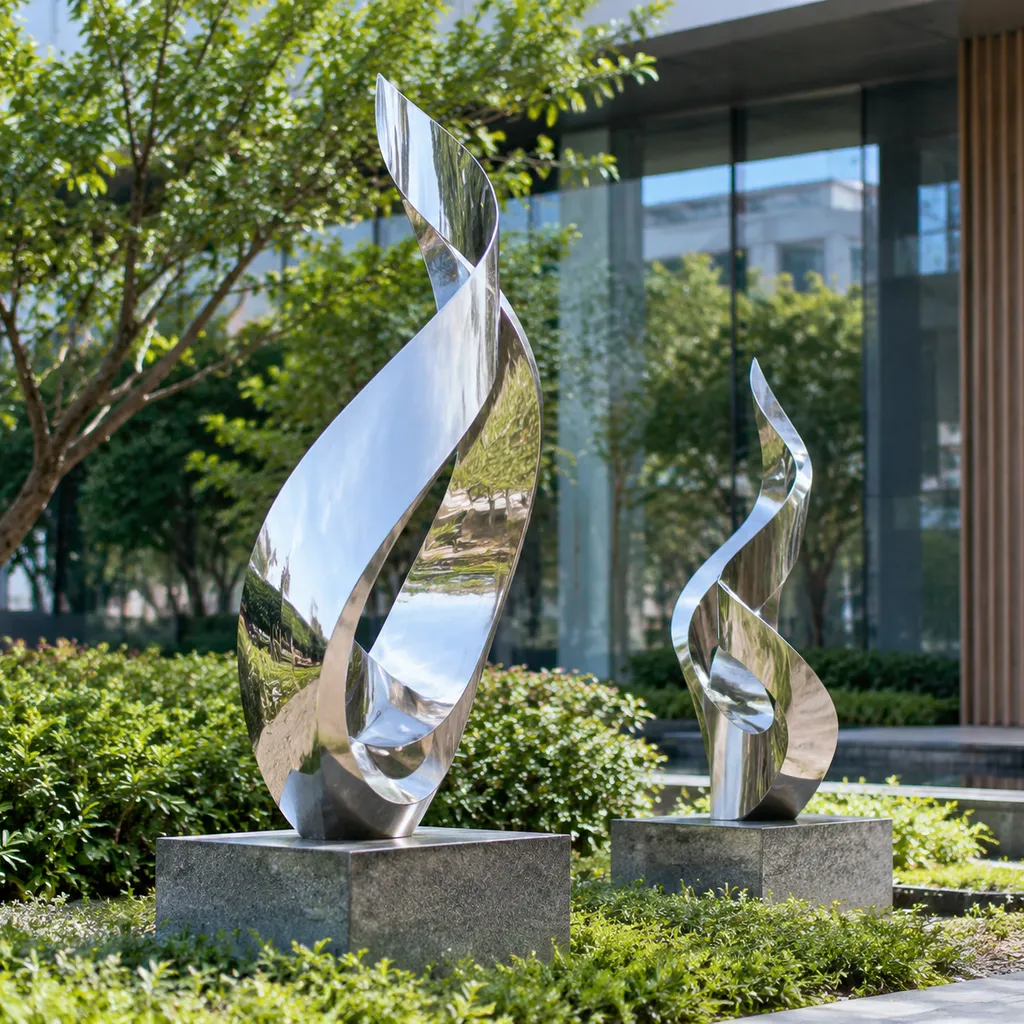
Choosing the right alloy is only half the battle. Even when comparing 316L vs 304 stainless steel for outdoor sculptures, neither grade is entirely maintenance-free. Both rely on a microscopic chromium-oxide passive film to block rust. If that film is damaged during fabrication or suffocated by environmental grime, corrosion starts. We follow strict shop and site protocols to ensure our public art installations stay pristine for decades.
Chemical Pickling and Passivation for Fresh Sculpture Welds
Welding introduces intense heat that depletes chromium along heat-affected zones, leaving heat tint that will quickly corrode outdoors if ignored.
- Pickling: We apply an acid pickling paste or bath to dissolve high-temperature oxide scale and strip out free iron embedded during grinding.
- Passivation: After pickling, we use a dedicated citric or nitric acid chemical passivation treatment. This accelerates the formation of an even, chromium-rich passive layer across the entire sculpture surface.
- The Alloy Factor: While 304 requires aggressive, meticulous passivation to survive standard inland conditions, 316L benefits from the added molybdenum, which rebuilds its protective layer faster and forms a tighter shield against pitting corrosion.
Routine Cleaning Schedules to Prevent Contaminant Buildup
Airborne chlorides, soot, and organic debris trap moisture against the metal, triggering crevice corrosion over time. In contemporary metal sheet sculpture work, flat planes and recessed geometric folds collect these contaminants faster than curved profiles.
EnvironmentRecommended GradeCleaning FrequencyProcedureInland / Rural304 Stainless SteelEvery 6 to 12 monthsLow-pressure freshwater rinse, mild neutral soap, soft microfiber wipe-downUrban / Light Smog304 or 316LEvery 4 to 6 monthsFreshwater wash with non-ionic detergent to remove hydrocarbon falloutMarine / Saline (Within 5 km of coast)316L Stainless SteelEvery 2 to 3 monthsHigh-flow freshwater washdown to flush crystallized salt deposits
Removing Tea Staining and Surface Iron Contamination
Tea staining stainless steel produces an unsightly brown surface discoloration that ruins public art aesthetics long before it causes structural damage. It frequently strikes 304 placed in harsh air, or any alloy exposed to grinding dust from nearby carbon steel tools.
- Never Use Carbon Steel Tools: Always isolate stainless steel finishing. Never use standard carbon wire wheels, steel wool, or contaminated sanding discs, as they embed microscopic carbon steel particles directly into the sculpture skin.
- Chemical Decontamination: For localized tea staining, we avoid abrasive grinding that alters the uniform grain or mirror polish. Instead, apply a phosphoric-acid-based surface cleaner to dissolve iron oxides safely.
- Re-Passivation: Once the brown stain is cleared, spot-treat the area with a liquid passivating solution and rinse thoroughly with deionized water to restore the protective film immediately.
Frequently Asked Questions: 316L vs 304 Stainless Steel for Outdoor Sculptures
Will 304 stainless steel rust if left outdoors?
Yes, under the right conditions. While 304 won’t rust through like carbon steel, it is vulnerable to surface oxidation:
- Inland and rural zones: 304 remains bright and clean for decades with basic washdowns.
- Coastal and marine environments: Airborne chlorides break down the passive chromium oxide layer, causing brown surface discoloration known as tea staining stainless steel and localized pitting corrosion.
- High-pollution corridors: Industrial sulfur and road salts will degrade a 304 finish if left unwashed.
Why do public art commissions specify 316L stainless steel?
Public art installations are designed for multi-decade, low-maintenance lifecycles. Municipalities and institutional clients demand marine grade stainless steel because the added molybdenum provides essential protection against de-icing salts, coastal winds, and chemical pollution. Commissioning agencies specify 316L for timeless strength stainless steel metal sculpture projects to avoid expensive municipal cleaning contracts, mechanical re-polishing, and premature aesthetic failure.
Can you weld 304 and 316L stainless steel together on one sculpture?
Yes, you can weld them together without structural galvanic issues because both belong to the austenitic stainless steel family and share nearly identical thermal expansion rates:
- Filler wire selection: Always weld with ER316L filler metal to maintain corrosion resistance across the weld puddle.
- Corrosion vulnerability: The overall structure will only perform up to the environmental limits of the 304 components.
- Placement strategy: Keep 304 sections elevated and dry, while using 316L for base plates, splash zones, and hidden drainage cavities.
How does surface finish affect corrosion resistance on metal art?
The smoother the surface, the higher the corrosion resistance. Surface texture is measured by roughness average (Ra):
- Mirror polish (low Ra): A directional-free mirror finish stainless steel gives dirt, airborne salts, and moisture no microscopic crevices to grip, maximizing passive layer integrity.
- Satin or brushed finish (higher Ra): Linear grain lines create micro-grooves that trap atmospheric contaminants, accelerating localized pitting.
- Bead-blasted textures: Provide the highest surface area for contamination and require frequent passivation and washing when placed outdoors.

 English
 German
 French
 Italian
 Panjabi
 Chinese
 Spanish
 Arabic
 Hindi