
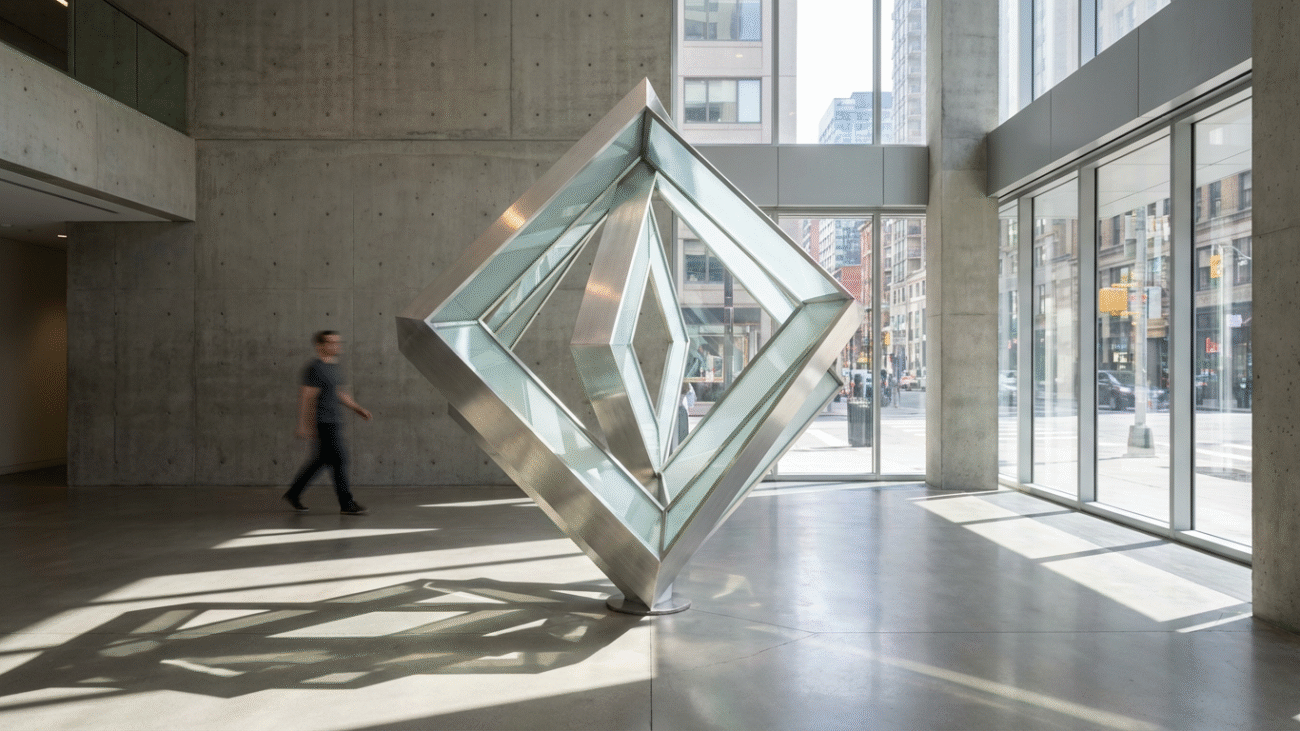
When landscape architects, civic planners, and private collectors search for the best kinetic sculptures, they want to understand how fluid physical movement transforms static outdoor spaces into living environments. Far beyond generic decorative spinners, a genuine escultura de arte cinético is an engineered architectural installation where motion—powered by wind currents, balanced counterweights, or hidden motorized drives—forms the core of its artistic identity. Whether you are exploring iconic landmarks or specifying a bespoke centerpiece commissioned through custom stainless steel sculpture fabrication, this guide breaks down the mechanics, materials, and direct manufacturing principles behind permanent kinetic art.
Engineering a Custom Kinetic Landmark for Your Next Project?
Artvision bridges sculptural vision and dynamic mechanical physics. We partner with general contractors, commercial developers, and landscape architecture studios to fabricate heavy-gauge wind-driven and motorized sculptures backed by structural FEA wind-load calculations, sealed industrial bearings, and 1:1 workshop trial pre-assemblies.
¿Qué es la escultura de arte cinético?
A true kinetic sculpture is a three-dimensional artwork engineered specifically to move in a controlled, rhythmic, and predictable manner. Unlike standard static monuments, its aesthetic dialogue changes continuously with ambient weather, natural wind shear, or programmed mechanical cycles.
Core Actuation Forces
Most commercial and civic kinetic installations rely on precise physical drivers:
- Wind Energy: Multi-axis rotors, counterbalanced wind vanes, and aerodynamically profiled sails.
- Precision Electric Drives: Sealed, low-RPM industrial motors designed for continuous or programmed indoor lobby operation.
- Gravity & Counterweights: Meticulously calculated pivot points allowing massive structural steel elements to oscillate with minimal frictional resistance.
- Hydraulic & Aquatic Systems: Water-weighted balancing basins integrated seamlessly with modern water features.
Kinetic Sculptures vs. Decorative Wind Spinners
Understanding the distinction between mass-market garden spinners and monumental kinetic art is critical for project procurement:
- Decorative Spinners: Lightweight stamped sheet metal with basic consumer-grade bearings, prone to high-speed erratic spinning and metal fatigue in high winds.
- Architectural Kinetic Artwork: Heavy-gauge marine-grade alloys, custom counterbalanced cantilevers, and fully enclosed industrial bearings. Movement is slow, graceful, and engineered to endure extreme Category 10+ storm wind loads.
Main Categories of Kinetic Art Sculptures
1. Wind-Powered Kinetic Sculptures
The most iconic outdoor category, operating entirely without electrical connections. These works rely on precision-balanced aerofoils and offset pivots to turn gentle coastal or park breezes into hypnotic, perpetual geometric patterns. Fabricated predominantly from marine-grade 316L stainless steel, they provide decades of maintenance-free performance.
2. Motorized & Electromechanical Installations
Widely specified for luxury corporate headquarters, airport terminals, and five-star hospitality atriums where ambient outdoor wind is absent. These systems incorporate ultra-quiet sub-30dB gearboxes, variable-frequency drives (VFD), and programmable logic controllers (PLC) to orchestrate gentle, timed choreographies throughout the day.
3. Gravity-Balanced & Pivot-Based Sculptures
Inspired by the pioneering engineering of George Rickey, these installations balance massive stainless steel blades or volumetric forms on ultra-low-friction needle or ceramic bearings. A slight thermal air updraft causes multi-ton metal assemblies to oscillate in slow, serene arcs.
Engineering Mechanics: How Modern Kinetic Sculptures Endure Outdoors
Sealed Industrial Bearing Housings
The operational lifespan of any moving artwork is dictated by its bearing assembly. Outdoor installations must avoid exposed bushings. High-specification fabrications utilize dual-sealed, spherical roller bearings housed in watertight stainless steel cassettes packed with synthetic marine fluorocarbon grease, completely isolating moving surfaces from rain, sand, and atmospheric salt spray.
Structural Wind-Load Calculations & Center of Gravity
Tall kinetic sculptures create dynamic cyclical fatigue stresses on their support masts. Professional engineering involves ANSYS finite element stress calculations (FEA) to confirm:
- Resonance frequency decoupling to prevent destructive wind flutter.
- Internal heavy structural steel fabrications providing rigidity against seismic and hurricane-force overturning moments.
- Engineered foundation anchor-bolt cage templates delivered in advance for civil engineering concrete footing integration.
Comparing Metal Alloys for Dynamic Art Installations
| Alloy Grade | Resistencia a la Corrosión | Mechanical Properties | Recommended Project Scope |
|---|---|---|---|
| ASTM 316L Stainless Steel | Maximum (Marine Grade) | High tensile strength, zero pitting in coastal salt spray | Waterfront public plazas, resorts, coastal civic centers. |
| ASTM 304 Stainless Steel | High (Standard Architectural) | Excellent cold-forming ductility, accepts 8K mirror polishing | Inland corporate parks, botanical gardens, retail courtyards. |
| Cast Silicon Bronze | High (Self-Protecting Patina) | Dense mass; optimal for counterweights and architectural bronze sculptures | Heritage plazas, memorial grounds, classical architectural nodes. |
| Architectural Brass & Copper | Moderate–High | Warm aesthetic, distinctive weathered oxides | Used in architectural brass features y copper sculpture finishes. |
Famous Kinetic Art Pioneers and Modern Benchmarks
Alexander Calder: Origin of Balance and Mobiles
Alexander Calder established the benchmark for suspended kinetic art in the mid-20th century. By balancing hand-cut steel plates and wires at mathematically calculated centers of gravity, his mobiles demonstrated that large metal masses could float effortlessly with subtle atmospheric currents.
George Rickey: Architectural Precision and Pure Geometry
George Rickey brought rigorous mechanical engineering to large-scale public art. His slender, oscillating stainless steel blades move in unhurried, silent arcs, proving that kinetic art can provide meditative architectural focus rather than chaotic motion.
Anthony Howe & Lyman Whitaker: Organic Wind Architecture
Contemporary masters have pushed multi-rotor wind sculptures into mesmerising digital complexity. Their intricate curved vanes catch ambient wind from all 360 degrees, creating undulating optical illusions that make heavy metal appear as fluid as water.
Commercial Value: Why Modern Developers Invest in Kinetic Landmarks
In competitive commercial real estate and urban development, static decor often blends into the background. Monumental kinetic artworks deliver quantifiable placemaking returns:
- Higher Visual Dwell Time: Dynamic movement naturally catches human peripheral vision, encouraging visitors to stop, record videos, and share experiences across digital media.
- Instant Brand Recognition: Transforms commercial office complexes and mixed-use developments into recognizable regional landmarks (“the plaza with the revolving sculpture”).
- Minimal Operational Maintenance: Unlike digital LED video walls or complex fountains, passive wind-driven sculptures incur zero electrical utility costs.
Custom Turnkey Fabrication Workflow at Artvision
Executing large-scale kinetic commissions requires tight coordination across art, mechanics, and logistics. Our integrated factory delivers a complete turnkey workflow:
- Parametric Concept & 3D Modeling: Translating conceptual sketches into digital Rhino/SolidWorks assemblies, checking mechanical clearances and balance coordinates.
- Dynamic Dynamic Balancing & Simulation: Virtual wind-tunnel simulations verify smooth rotational inertia and identify potential bearing stresses under gust conditions.
- Heavy Precision Metal Fabrication: Precision laser cutting, robotic welding, hand forging, and multiple stages of mechanical graining or 8K super-mirror polishing.
- 1:1 Full Workshop Pre-Assembly: Every kinetic piece is assembled and test-run under variable fan conditions inside our 12,000 m² workshop, verifying coordinate tolerances (≤±2.0mm) before export crating.
- Sequenced Export Logistics: Steel-reinforced wooden crating, marine moisture barrier packing, and engineered site foundation drawings provided for smooth local erection.
Partner Directly with a Precision Metal Sculpture Manufacturer
Artvision operates a specialized 12,000 m² manufacturing facility in Tianjin, China, delivering custom kinetic wind sculptures, monumental mirror stainless steel installations, and heavy architectural bronze monuments worldwide. Benefit from direct source pricing, zero trading markups, 1:1 workshop trial pre-assemblies, and international bilateral NDA protection.

 Spanish
 English
 German
 French
 Italian