

If you’ve ever stood in front of a gleaming stainless steel sculpture and wondered, “How on earth do they make that?”, you’re in the right place. In this guide, you’re going to see exactly how to make a stainless steel sculpture from first sketch to mirror-polished installation.
We’ll walk through the same core process we use at Artvision Sculpture Group for large outdoor public art:
from concept and 3D design, to armature engineering, to TIG welding, grinding, and that flawless mirror finish that turns heads from 100 meters away.
You’ll also see the honest split between DIY vs professional fabrication.
- Want to build a small stainless steel art piece in your garage with basic tools? We’ll show you what’s realistic, what it costs, and where you must not cut corners.
- Planning a multi-meter large-scale public stainless steel sculpture? We’ll break down why things like wind loads, steel grade selection, and structural engineering move you into professional studio territory.
By the end, you’ll understand the full stainless steel sculpture process: the tools you need, the key decisions that affect durability and cost, and the real timeline from idea to permanent installation. And if you decide that a complex, high-value project is better handled by specialists, you’ll know exactly what a studio like Artvision Sculpture Group can do for you.
Concept & Design Phase
You want a powerful stainless steel sculpture, but you’re not sure where to start, how big you can go, or how to keep it from bending, cracking, or tipping over outdoors. When I walk clients through how to make stainless steel sculpture the right way, we always begin with a tight concept and a safe, buildable design.
Sketching And Maquettes
Before you touch stainless steel, you need a clear form and proportion.
- Start with fast, loose sketches from several angles
- Push the design toward clear, bold silhouettes – they read best in public spaces
- Build small maquettes using cheap, forgiving materials:
- Clay – best for organic, abstract stainless steel sculpture forms
- Foam – easy to carve and sand into smooth curves
- Plaster – good for sharper planes and edges
Use maquettes to test:
- Overall balance and gesture
- How light hits curves and planes
- Where seams, joints, and supports might live in the final metal sculpture
Pro tip: If the maquette looks dull or unstable at 20–30 cm tall, it will not magically improve at 5–10 meters.
Turning The Design Into A 3D Model
Once the form works in your hands, translate it into a digital 3D model. This is the backbone of a professional stainless steel sculpture process.
Common tools:
- Rhino – excellent for precise, buildable surfaces and structural details
- ZBrush – powerful for sculpting organic, flowing forms
- Blender – free, flexible, and great for overall design and visualization
Your 3D model should:
- Match the maquette’s proportions and character
- Include approximate plate thickness, tubes, and main structural members
- Allow you to slice the sculpture for waterjet cutting or laser cut stainless steel sculpture parts
Aim for a “fabrication-ready” model, not just something that looks good on screen.
Scaling Up For Outdoor Stainless Steel Art
Scaling up is where many DIY stainless steel sculpture projects fail. Big doesn’t just mean “blown up” – it means re-engineered.
When you scale the 3D model:
- Decide the final height based on viewing distance and location
- Thicken critical areas (edges, connections, cantilevers) instead of scaling everything equally
- Simplify tiny details that won’t read at distance or will be impossible to fabricate in stainless steel
For large-scale public art stainless steel projects, I always:
- Produce several scale views: human figure next to the sculpture, street context, skyline
- Check that access panels, welds, and supports are realistic for a real workshop, not just a render
Planning Wind Loads, Weight, And Structural Stability
Even the most beautiful design fails if it can’t survive wind, weather, and time. Structural engineering for metal sculptures must be part of your concept phase, not an afterthought.
Key checks for outdoor stainless steel sculptures:
- Wind loads:
- Tall, slender forms and big surfaces act like sails
- Identify “wind-catching” faces and add openings, ribs, or internal frames
- Weight and center of gravity:
- Keep heavy mass low to avoid tipping
- Avoid large overhangs without serious internal support
- Structural stability:
- Plan a stainless steel armature or internal frame from day one
- Reserve space for hidden base plates, anchor bolts, and footings
- Decide where you need full structural welds vs. cosmetic welds
For major public or 316 stainless steel sculpture in harsh climates, we often bring in a structural engineer early. That lets us balance:
- Visual lightness
- Real-world safety
- Efficient fabrication and installation
When you treat the concept and design phase as an engineering-aware art process, every later step—from TIG welding stainless steel sculpture parts to polishing a mirror finish—becomes smoother, safer, and more predictable.
2. Choosing the Right Stainless Steel Grade
Picking the right stainless steel is the difference between a sculpture that looks great for 20+ years and one that starts staining in a few seasons.
304 vs 316/316L vs Duplex for Sculpture
- 304 stainless steel
- Best for: indoor sculptures or mild outdoor climates (low pollution, low salt).
- Pros: Easy to source, easier to form and polish, lower cost.
- Cons: Can tea-stain or pit near the sea, in cities, or in humid, polluted areas.
- 316 / 316L (marine grade) stainless
- Best for: outdoor stainless steel sculptures, coastal cities, high humidity, public spaces.
- Pros: Much better corrosion resistance, holds a mirror finish outside far longer.
- Use 316L if you’re doing a lot of welding (low carbon = less risk of weld corrosion).
- This is my default for mirror polished stainless steel art in the open.
- Duplex stainless steel
- Best for: large-scale public art stainless steel with heavy structural loads or extreme coastal / industrial environments.
- Pros: Higher strength, very good corrosion resistance.
- Cons: Harder to fabricate and weld, more expensive, usually for engineered structures, not small DIY builds.
Sheet, Tube, or Cast Stainless Parts
- Sheet stainless steel
- Use for: skins, petals, abstract stainless steel sculpture surfaces, mirror-polished shells.
- Good for laser cut / waterjet cut stainless steel art and folded forms.
- Tube and pipe
- Use for: frames, legs, spines, armatures, visible linear elements.
- Round, square, or rectangular tube is ideal for stainless steel armature design and hidden support.
- Cast stainless steel
- Use for: Complex organic details, repeated elements, solid forms.
- Usually done by a custom metal sculpture studio or foundry, not a home shop.
Thickness Guidelines (Quick Rules)
These are general starting points; local codes and engineering may demand more:
- Small sculptures (tabletop to ~0.8 m / 2.5 ft)
- Sheet: 1.0–2.0 mm
- Tube: 1.2–2.0 mm wall
- Medium sculptures (~0.8–2.5 m / 2.5–8 ft)
- Sheet: 2.0–3.0 mm
- Tube: 2.0–3.0 mm wall
- Large outdoor sculptures (2.5 m+ / 8 ft+)
- Sheet: 3.0–6.0 mm and up
- Tube/structure: 3.0–10 mm wall, often engineered with I‑beams or heavy sections.
If I’m unsure, I always overspec thickness slightly for public art stainless steel installation. Weight is cheaper than a failure.
Weather, Corrosion & Outdoor Performance
- Harsh coastal / marine (salt spray, harbors, resorts):
- Go 316/316L minimum; consider duplex for very large structural pieces.
- Avoid crevices where salt can sit; design for drainage.
- Urban / industrial (pollution, acid rain):
- Prefer 316L, especially for mirror polished stainless steel sculptures or high-touch public art.
- Regular cleaning and passivation help the surface stay bright.
- Dry inland climates:
- Good quality 304 can work well if fabrication is clean (no contamination by carbon steel) and the finish is properly done.
For complex projects or public work, I usually loop in a professional stainless steel sculpture foundry to validate grades and thickness based on site conditions and scale, similar to how we plan long‑term durability in our own large outdoor stainless steel sculpture projects.
3. Tools & Equipment You’ll Need for Stainless Steel Sculpture
Basic DIY stainless steel sculpture tools (home setup)
If you’re starting small at home, you don’t need a full factory. You do need a clean, organized space and a few solid basics:
- Cutting & shaping
- Angle grinder (with cutting, grinding, flap discs)
- Jigsaw with metal blades or a small band saw
- Hand files, deburring tools, metal snips (for thin sheet)
- Welding (entry level)
- Small TIG welder or quality MIG with stainless wire
- Welding clamps, magnets, and simple jigs to hold parts
- Measuring & layout
- Steel ruler, tape measure, square, scribe, center punch
- Cardboard or MDF templates for complex shapes
- Finishing
- Sandpaper (80–2000 grit), Scotch-Brite pads
- Polishing wheels for the grinder or bench polisher
With this setup, you can handle most DIY stainless steel sculpture projects up to small/medium size.
Pro-level stainless steel sculpture fabrication tools
For large-scale, mirror polished stainless steel art or public work, I rely on industrial equipment for accuracy and repeatability:
- Cutting
- CNC waterjet cutting stainless steel art parts
- Fiber laser cut stainless steel sculpture profiles
- Plasma cutting for thicker structural elements
- Forming
- Plate rollers for large curves in sheet
- Section rollers for tube and flat bar
- Hydraulic press brake for sharp folds and angles
- Welding & automation
- High-end TIG welding stainless steel sculpture stations
- Robotic welding cells for repetitive joints
- Positioners and rotators for big, heavy pieces
- Finishing & polishing
- Industrial belt sanders and linishers
- Dedicated mirror-polish lines for #8 mirror finish
- Bead blasting booths for satin and bead blasted stainless steel finish
This is the level needed for large-scale public art stainless steel and tight tolerances.
Essential safety gear for stainless steel cutting & welding
Stainless is unforgiving. I don’t let anyone in my shop work without:
- Personal protection
- Auto-darkening welding helmet (true-color lens)
- Safety glasses + face shield for grinding
- Cut-resistant gloves + welding gloves
- Hearing protection (earmuffs or plugs)
- Flame-resistant clothing, leather sleeves, closed shoes
- Respiratory protection
- At minimum: quality dust mask/respirator for grinding
- Better: welding respirator or PAPR system for fumes
Stainless steel dust and fumes are not something you “get used to” – you avoid them.
Setting up a safe stainless steel sculpture workspace
Even in a small studio, I set things up with safety and workflow in mind:
- Ventilation
- Cross-ventilation or exhaust fan near welding/grinding area
- Fume extractor or mobile welding fume arm if welding often
- Fire control
- No flammables near the welding and grinding zone
- Fire extinguisher rated for electrical and metal work, easy access
- Layout
- Clear walking paths, no cables underfoot
- Solid workbench with metal top and grounding point
- Separate “dirty” zone (cutting/welding) and “clean” zone (polishing)
- Storage
- Racks for sheet and tube, stored off the floor
- Tool wall or shadow board so everything is visible and reachable
Once your tools, safety gear, and layout are under control, the stainless steel sculpture process becomes smoother, faster, and a lot less risky.
Creating the Armature for Stainless Steel Sculpture
When people ask how to make stainless steel sculpture that actually survives outdoors, I always start with the armature. It’s the hidden internal frame that carries the weight, resists wind, and keeps the artwork from twisting, leaning, or cracking over time.
What Is an Armature?
The armature is your sculpture’s skeleton:
- It transfers load from thin stainless steel skin to the base/foundation
- It keeps organic, abstract stainless steel forms stable in wind and temperature changes
- It lets you build lighter, more dynamic shapes without risking structural failure
For any outdoor metal sculpture fabrication, a solid stainless steel armature design is non‑negotiable.
Mild Steel vs Stainless Steel Frame
I choose frame material based on environment, budget, and size:
| Frame Material | When I Use It | Pros | Cons |
|---|---|---|---|
| Mild steel | Interior art, temporary pieces, fully sealed armatures | Cheaper, easy to weld | Rust risk if moisture gets in |
| Stainless (304/316) | Outdoor and public art, marine or humid zones | Corrosion resistant, low maintenance | Higher cost, needs clean welding |
For large-scale public art stainless steel in coastal or harsh climates, I strongly prefer 316 stainless steel armatures.
Engineering for Strength and Stability
To make sure the structure supports weight and resists movement, I:
- Work with structural engineering for metal sculptures on big or tall pieces
- Use tube and box sections instead of solid bars to keep strength high and weight manageable
- Tie the internal frame directly into the mounting base and anchor system
- Design for wind loads, vibration, and dynamic forces, not just static weight
Design Details That Prevent Deformation
Small details decide whether a sculpture stays straight for 20+ years:
- Cross-bracing inside hollow forms to stop racking and twisting
- Gussets and ribs at high‑stress corners, weld joints, and transitions
- Drainage holes so water can’t sit inside and cause hidden corrosion
- Thermal movement gaps so skins and frames can expand/contract without warping
In my studio, we treat the armature like an engineered product, not an afterthought. That’s how we stay truly committed to quality production and long-term stability for outdoor stainless steel art.
Cutting & Shaping Stainless Steel Sculpture
Hand cutting vs plasma, waterjet & laser
For the stainless steel sculpture process, cutting choice controls both quality and cost:
- Hand cutting (angle grinder, jigsaw)
- Good for DIY stainless steel sculpture and small pieces
- Cheap, flexible, but slower and less precise
- Best for rough shapes, test pieces, simple abstract stainless steel sculpture
- Plasma cutting
- Fast for thicker plate
- Edges need more grinding, heat-affected zone is larger
- Good for structural parts, bases, hidden joins
- Waterjet cutting stainless steel art
- No heat, super clean edge, keeps the metal flat
- Ideal for detailed outdoor metal sculpture fabrication and complex patterns
- Higher cost, usually done at a professional stainless steel sculpture studio
- Laser cut stainless steel sculpture
- Very precise, fast, perfect for repeatable parts and crisp geometry
- Minimal kerf, but some heat, so you still need proper settings
- Great for mirror polished stainless steel art where clean edges matter
Rolling, bending & forming sheet and tube
For 304 or 316 stainless steel sculpture, I rely on a mix of forming methods:
- Slip rollers / plate rollers – for cylinders, cones, and smooth arcs in sheet
- Section rollers – for bending tube and flat bar into rings and large curves
- Press brake – for sharp folds, faceted designs, hidden structural flanges
- Hand forming with mallets/forms – for organic curves in thinner sheet
Thin sheet (1.5–3 mm) bends easily but needs good internal support. Thicker plate needs proper rolling equipment or a pro shop.
Techniques for smooth organic curves & complex shapes
To get those flowing, contemporary stainless steel sculpture lines:
- Break complex shapes into smaller, repeatable panels that you roll or bend, then weld together
- Use templates and jigs (MDF, plywood, 3D-printed forms) to keep curves consistent
- For large-scale public art stainless steel, combine digital 3D modeling with CNC-cut ribs that guide every curve
- Think in “skins over a skeleton”: stainless steel skin + stainless steel armature design inside for support
Avoiding distortion & burn marks while cutting
Stainless steel moves when it heats up. To keep everything clean and flat:
- Use sharp discs/blades and correct cutting speed
- Keep the metal clamped and supported close to the cut
- Avoid long continuous cuts on thin sheet; stop and cool when needed
- For plasma/laser, dial in proper settings to reduce heat input
- Mask visible areas with film or tape to protect from sparks and scratches
- Leave a tiny “finishing allowance” you can grind back for a perfect edge
When we fabricate 304 vs 316 stainless steel for sculpture, we adjust cutting and forming settings for each grade. 316 is tougher but more stable outdoors, especially for marine grade stainless steel sculpture near the coast.
Welding Stainless Steel Sculpture Like a Pro
TIG welding stainless steel sculpture (304 & 316)
For stainless steel sculpture fabrication, I stick to TIG welding for control and clean seams, especially on mirror polished stainless steel art.
- Use DC TIG, electrode negative (DCEN)
- Torch angle: ~10–15° off vertical, tight arc length
- For most 304 stainless steel sculptures:
- 1–3 mm sheet: 40–90 A
- 3–6 mm plate: 90–160 A
- For 316 stainless steel sculpture (marine / coastal): slightly more amps than 304 for the same thickness
Settings, filler rods & shielding gas
Dialing in clean welds is the difference between “DIY” and professional outdoor metal sculpture fabrication.
- Filler rods:
- 304 stainless: ER308L
- 316 / 316L stainless: ER316L (preferred for marine grade stainless steel sculpture)
- Gas:
- Pure Argon, 99.99%, 8–12 L/min for most work
- Larger cups + gas lens for mirror polished stainless steel seams
- Key tips:
- Use a foot pedal for heat control
- Avoid overwelding – small, consistent beads are easier to grind and polish
- Keep everything clean and degreased to avoid porosity and rust spots later
Back purging & avoiding “sugar” discoloration
If you’re doing full penetration welds on hollow forms or tubing, you must back purge.
- Seal the backside of the weld area
- Feed Argon into the inside of the tube or cavity
- Keep oxygen low (ideally <0.1%) to prevent:
- Crusty “sugar” on the inside of the weld
- Weak, brittle welds that can crack outdoors
- Ugly heat tint that’s hard to clean in high-polish stainless steel sculpture
No purge = strong chance of structural issues later, especially on large-scale public art stainless steel.
Full penetration vs cosmetic welds
I separate welds into structural and cosmetic on every project.
- Full penetration welds (backed or back purged):
- Use on bases, armatures, load paths, anchor points
- Needed for structural engineering for metal sculptures and public installations
- Cosmetic welds (partial penetration / fusion welds):
- Use on skins, seams that will be ground flush and polished
- Great for abstract stainless steel sculpture techniques where the weld itself isn’t carrying major load
For clients who demand seamless mirror polished stainless steel art, I overbuild the internal structure so the outer skin welds can stay as light, cosmetic, easy-to-polish TIG beads.
Grinding & Surface Finishing for Stainless Steel Sculpture
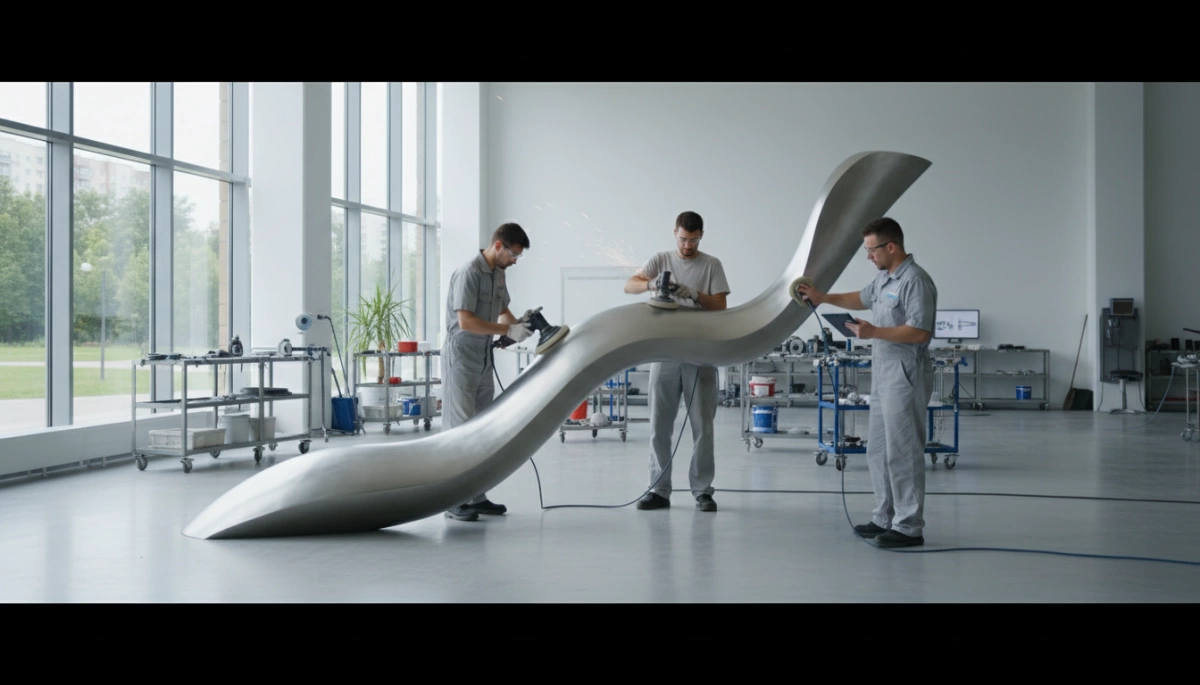
Finishing can make or break a stainless steel sculpture. I treat it as its own project, not an afterthought.
Step‑by‑Step: From Rough Grind to Mirror Polish
A simple, repeatable sanding path:
| Stage | Grit Range | Purpose | Notes |
|---|---|---|---|
| Rough grind | 40–60 | Remove welds, shape form | Use flap discs, keep moving to avoid heat |
| Leveling | 80–120 | Flatten and blend | Work in one direction, no deep scratches |
| Pre‑finish | 180–240 | Prep for satin or higher | This is the “truth” stage – flaws show up |
| Fine finish | 320–600 | Prep for mirror | Switch to non-woven pads for even texture |
| Pre‑polish | 800–1200 | Remove micro-scratches | Use compound on sisal or firm wheels |
| Mirror polish | 1500+ / buff | Final reflective finish | Soft wheel + fine compound, clean surface |
Tips:
- Never skip more than 2 grit steps.
- Cross-sand: change direction 90° each step so you can see old scratches.
- Keep stainless clean – wipe between stages to avoid contamination.
Finish Types: #4 Satin vs #8 Mirror vs Hairline vs Bead‑Blast
| Finish Type | Look | Typical Use | Pros | Cons |
|---|---|---|---|---|
| #4 Satin | Soft linear sheen | Contemporary outdoor pieces | Hides fingerprints, lower maintenance | Not super reflective |
| #8 Mirror | Highly reflective, almost like chrome | Feature sculptures, luxury spaces | Dramatic, “premium” feel | High labor, shows every defect |
| Hairline | Long, continuous grain, finer than satin | Minimalist, architectural style | Elegant, directional | Scratches stand out across the grain |
| Bead‑blast | Matte, smooth, non-reflective | Urban, industrial, large forms | Hides flaws, diffused light | Needs clean blasting media, harder to touch up on-site |
When clients ask for “mirror polished stainless steel art,” I always explain upkeep. Mirror looks amazing but demands more cleaning and better handling.
Tools, Abrasives & Compounds for Stainless Steel Finishing
Core setup I recommend for stainless steel sculpture finishing:
- Grinders & sanders
- Variable‑speed angle grinder (125/150 mm)
- Belt sander (handheld or station)
- Die grinder for tight areas
- Abrasives (stainless‑safe only)
- Ceramic or zirconia flap discs (40–120)
- Fiber discs & sanding belts (80–600)
- Non‑woven wheels and pads (e.g., Scotch‑Brite) for satin/hairline
- Polishing gear
- Bench polisher or angle‑mounted buffing wheels
- Sisal wheels (cutting) + cotton wheels (finishing)
- Compounds:
- Cutting compound (brown/grey) – remove 600–800 grit marks
- Finishing compound (green/white) – mirror shine
- Support
- Clean microfiber cloths
- Dedicated stainless steel cleaners (no chlorides)
- Masking tape to protect finished zones while working nearby
Time & Cost Reality of Polishing Stainless Steel Sculpture
Polishing is where budget and patience get tested. I’m always direct about it with clients.
What to expect:
- Labor heavy: Finishing can be 30–50% of total fabrication time.
- Mirror polish multiplies cost:
- Small piece (desktop size): finishing can rival the metal cost.
- Large public art: mirror finish can add thousands in labor and consumables.
- Complex shapes cost more:
- Tight curves, inside corners, and layered forms are slow to access.
- Every weld line must be invisible for a true #8 mirror.
Where costs come from:
- Abrasive discs, belts, and wheels wear fast on stainless.
- Polishing compounds, cleaning materials, and masking.
- Skilled labor – mirror polishing is a craft, not just “extra sanding.”
For outdoor stainless steel sculpture, I usually steer global clients toward #4 satin or bead‑blast for a clean, professional look with realistic maintenance and cost, and reserve full mirror polish for key focal areas or smaller statement pieces.
Patina & Coloring Options for Stainless Steel Sculpture
When I design a stainless steel sculpture, color and patina are where the piece really starts to feel “finished.” Here’s how I approach it in the studio.
Heat Coloring Stainless Steel Art
Heat is the most direct way to add character to stainless steel.
What it does:
- Colors range from straw, gold, purple, blue, to dark bronze
- Works best on 304 and 316 stainless steel
- Suits abstract stainless steel sculpture and small accent areas
How we do it:
- Use a torch or controlled oven heating
- Keep the surface clean and grease‑free
- Warm up slowly and stop at the color you want
- Seal with a clear high‑temp lacquer if needed
Pros / Cons
| Point | Heat Coloring Stainless Steel Sculpture |
|---|---|
| Look | Organic, unique, “alive” color shifts |
| Control | Medium – can be tricky to repeat exactly |
| Durability | Good indoors, needs protection outdoors |
| Cost | Low for DIY stainless steel sculpture |
Electro-Chemical & “Anodic” Style Finishes
For more controlled color on stainless steel, I use electro-chemical coloring systems.
Key features:
- Uses electric current + special solutions
- Creates thin oxide layer that shifts color
- No paint, no flaking – color is in the surface
Best for:
- Mirror polished stainless steel art (colors pop hardest on a #8 polish)
- Small to medium 316 stainless steel sculpture elements
- Logos, patterns, or subtle gradients
Pros / Cons
| Point | Electro-Chemical Colored Stainless Steel |
|---|---|
| Look | Clean, modern, consistent |
| Control | High – repeatable shades |
| Durability | Good outdoors if properly sealed |
| Cost | Medium – needs pro equipment |
PVD Coated Stainless Steel Sculpture
For large public or outdoor stainless steel art, I often spec PVD (Physical Vapor Deposition) when the budget allows.
What PVD gives you:
- Extremely thin, hard coating fused to the stainless
- Popular colors: gold, rose gold, black, bronze, champagne, rainbow
- Works very well on mirror polished stainless steel sculptures
Why I like it for public art:
- Very scratch‑resistant
- Color is stable under UV
- Ideal for high‑touch urban installations
Pros / Cons
| Point | PVD Coated Stainless Steel Sculpture |
|---|---|
| Look | Luxury, high-end architectural feel |
| Durability | Excellent outdoors & in marine areas |
| Maintenance | Low – just wash and wipe |
| Cost | Higher – best via professional studio |
Outdoor Performance Over the Years
How each finish behaves outside is a big deal when I plan large-scale public art stainless steel projects.
General rules:
- Raw satin / bead-blast
- Shows dirt fastest
- Easy to repolish or re‑bead‑blast
- Mirror polished stainless steel
- Reflects heat and UV well
- Easier to clean, harder to scratch to the eye
- Heat colored
- Can soften or shift if overheated in the sun or near heat sources
- Needs clear coats or regular maintenance in harsh climates
- Electro-chemical finishes
- Good for urban environments, not ideal for heavy abrasion zones
- PVD coating
- Top choice for coastal, marine grade stainless steel sculpture
- Best long-term color stability and corrosion resistance
My simple outdoor recommendation:
- Urban / public, high traffic:
- 316 or duplex stainless, satin or mirror finish, PVD where budget allows
- Coastal / marine:
- 316/316L stainless steel sculpture + PVD or very high-quality polish
- Private garden / residential:
- 304 vs 316 stainless steel for sculpture: 304 is fine inland, 316 for coastal
- Heat coloring and electro-chemical finishes work well with basic upkeep
If you want your stainless steel sculpture to look sharp after 10+ years outdoors, the right combo of grade, finish, and coating matters more than any single coloring trick. This is exactly what I optimize for in my studio on every outdoor metal sculpture fabrication project.
9. Base, Mounting & Installation for Stainless Steel Sculpture
Hidden vs Visible Bases for Stainless Steel Sculptures
When I design a stainless steel sculpture, I decide early whether the base is part of the artwork or completely invisible:
- Hidden bases (great for abstract stainless steel sculpture in plazas/parks):
- Base sits below grade in concrete.
- Sculpture appears to “grow” from the ground.
- Needs accurate anchor bolt layout and proper drainage.
- Visible bases (pedestals, plinths, frames):
- Can be stainless, stone, concrete, or painted steel.
- Acts as a visual frame and protects the sculpture from direct impact.
- Easy to access anchors and inspect over time.
For outdoor stainless steel art, I usually use 316 or duplex stainless at the base connections to handle water, salt, and de-icing chemicals.
Anchor Systems & Footing Design for Public Art
For public and large-scale stainless steel sculpture installation, the anchoring is non‑negotiable. I work with structural engineers to match sculpture loads and local codes:
- Common anchor methods:
- Base plate + anchor bolts set into reinforced concrete.
- Embedded sleeves for adjustability and future removal.
- Grout leveling under base plates for full contact.
- Footing design basics (always engineered):
- Sized for weight, wind load, and overturning.
- Reinforced concrete with rebar and proper depth below frost line.
- Designed to resist vibration and long‑term movement.
If you’re installing public art stainless steel, never guess footing size—have it calculated, stamped, and documented.
Transporting Large Metal Sculptures Safely
Once a stainless steel sculpture leaves the studio, transport risk becomes the main issue. I plan logistics before fabrication finishes:
- Break the sculpture into sections when possible for:
- Smaller trucks or containers.
- Easier lifting and on‑site assembly.
- Transport protection:
- Wrap mirror polished stainless steel surfaces with foam + stretch film, then crate if needed.
- Use soft slings and protect edges with corner guards.
- Secure with rated straps and chains to certified tie‑down points.
Global clients often ship stainless steel sculpture by sea; in those cases I specify robust export crating and corrosion‑resistant packing.
Cranes, Rigging & On‑Site Installation Planning
On-site installation of large stainless steel sculpture is a project in itself. I treat it like a mini construction job:
- Pre‑planning:
- Site survey, access routes, ground conditions, overhead wires.
- Choose crane size and type based on weight, radius, and height.
- Confirm lifting points built into the sculpture frame.
- Rigging plan:
- Certified shackles, slings, and spreader bars where needed.
- Test lift away from the footing first, then set onto anchors.
- Keep a tag line on the sculpture to control rotation.
- On-site workflow:
- Close coordination with crane operator, rigging crew, and installer.
- Final leveling, torqueing anchor nuts, and grouting base if required.
- Clean down the stainless surface after installation and document the condition.
Whether it’s a DIY stainless steel sculpture or a large public stainless steel installation, the base, anchors, and installation plan are what keep the artwork safe for decades—not just the welds or the polish.
Stainless Steel Sculpture Cost Breakdown & Timeline
Small DIY stainless steel sculpture cost
If you’re building a small stainless steel sculpture at home (tabletop to ~1 m high), here’s a realistic range:
- Materials (304 stainless sheet/tube, consumables):
- Basic piece: $80–$300
- More complex (thicker plate, more material): $300–$800
- Tools & equipment (if you don’t already own them):
- Entry-level welder, angle grinder, basic clamps, PPE: $500–$1,500 one‑time
- Optional upgrades (small TIG, better grinders, polishers): $1,500–$3,000
- Finishing & extras:
- Sanding discs, flap wheels, compounds: $50–$200 per project
- Simple base or stand: $50–$250
For a first DIY stainless steel sculpture, most people land in the $600–$2,000 range total, including tool buy‑in.
Large-scale stainless steel sculpture cost range
For professional large-scale public art stainless steel sculptures (2–10+ m high), pricing jumps fast because of engineering, safety, and logistics:
- Small public piece (2–3 m):
- $15,000–$50,000
- Medium landmark sculpture (3–6 m):
- $50,000–$250,000
- Major statement work (6–12+ m, complex mirror polished stainless steel art):
- $250,000–$1M+
Big drivers of cost:
- Grade choice: 316 / 316L marine grade stainless steel sculpture can add 20–40% in material costs vs 304.
- Finish: True #8 mirror polish can double or triple labor hours versus a simple bead‑blasted or satin finish.
- Complex geometry: More CNC, waterjet cutting, 3D rolling, and robotic welding.
- Engineering & certification: Structural engineering, stamped drawings, and site approvals.
How long each stage usually takes
For a serious outdoor stainless steel sculpture, here’s a rough timeline (professional studio level):
- Concept & design:
- Simple piece: 1–3 weeks
- Public art / large abstract stainless steel sculpture: 4–12+ weeks (includes approvals)
- Engineering & 3D modeling (Rhino/Blender, structural check):
- 2–8 weeks, depending on scale and local building code requirements
- Fabrication (cutting, TIG welding stainless steel sculpture, fitting armature):
- Small/medium: 4–10 weeks
- Large landmark: 3–9 months
- Finishing, polishing & coloring:
- Simple satin (#4) or bead‑blasted stainless steel finish: 1–3 weeks
- Full mirror polished stainless steel to #8: 3–8+ weeks
- Base, transport & installation:
- Footing, anchor systems, curing concrete: 2–4 weeks (depending on climate)
- Crating, shipping, customs (for global clients): 1–6 weeks
- On‑site installation with crane & rigging: 1–7 days
From first sketch to fully installed large-scale public art stainless steel, global clients usually see 6–18 months total.
Where the time and money really go
Most people think the cost is in the metal. It isn’t. In real projects, the big chunks are:
- Labor:
- Skilled TIG welding, fitting, and finishing is the #1 cost driver.
- Mirror finish pieces can have 40–60% of total budget in grinding and polishing alone.
- Engineering & design:
- Structural engineering for outdoor metal sculpture fabrication, 3D modeling, and shop drawings can be 10–25% of the budget.
- Finishing:
- Mirror polished stainless steel art requires multiple sanding stages, buffing, and inspection. It’s slow, detail‑driven work.
- Logistics & installation:
- Cranes, rigging, global freight, customs, on‑site crews, and concrete work can easily be 10–30% of a public art stainless steel installation.
- Materials & overhead:
- Stainless steel (especially 316L and duplex) is not cheap, but usually 20–30% of the total, not more.
In short:
- DIY stainless steel sculpture: Most of your money goes into tools and your own time.
- Commissioned large-scale stainless steel sculpture: Most of the budget goes into skilled labor, finishing, engineering, and safe installation, not just the steel itself.
Common Mistakes in Stainless Steel Sculpture
When people search “how to make stainless steel sculpture,” they usually don’t see the hidden failures. These are the issues I see most often in real projects.
Wrong Stainless Steel Grade Outdoors
Picking the wrong grade is the fastest way to ruin outdoor stainless steel art.
- For coastal, poolside, or high‑pollution sites, I treat 316/316L as the minimum; 304 will stain and pit.
- I use 304 mainly for indoor work or sheltered areas with low corrosion risk.
- For very large public art stainless steel installations, duplex grades are worth considering for extra strength and corrosion resistance.
- I always match fasteners, brackets, and hidden hardware to the main alloy to avoid galvanic corrosion and rust “bleed.”
Warping, Distortion, Heat Damage
Welding techniques for stainless steel art can make or break the sculpture.
- I control heat input: short weld runs, staggered welds, proper clamping, and cooling between passes to avoid distortion.
- I don’t mix cutting methods at random; plasma and oxy cutting can overheat edges, so I leave extra material for grinding or switch to laser or waterjet cutting stainless steel art where possible.
- I keep fixtures and jigs ready so complex shapes don’t twist out of alignment during TIG welding stainless steel sculpture.
Rust Spots, Contamination, Poor Prep
Stainless still “rusts” if the surface is contaminated or badly finished.
- I never grind stainless steel next to carbon steel; dust and particles cause orange rust spots later.
- I use dedicated stainless steel wire brushes and flap discs and avoid using tools that have touched mild steel.
- After heavy work, I clean, degrease, and often passivate the surface before going for satin, bead‑blasted, or mirror polished stainless steel art finishes.
Structural Mistakes That Show Up Years Later
Most failures in outdoor metal sculpture fabrication are structural, not cosmetic.
- I design the stainless steel armature to handle wind loads, vibration, and thermal movement, not just static weight.
- I avoid thin wall tube in high‑stress zones; local buckling and cracking show up after repeated loading.
- I don’t rely on cosmetic welds where full‑penetration welds or hidden reinforcement are needed.
- For large‑scale public art stainless steel, I involve structural engineering early to avoid leaning, cracking, or base failures years after installation.
DIY vs Professional Studio: How to Make Stainless Steel Sculpture
When DIY Stainless Steel Sculpture Makes Sense
If you’re asking how to make stainless steel sculpture at home, DIY can work when:
- You’re building small indoor pieces or simple abstract stainless steel sculpture.
- You’re okay with a learning curve on cutting, TIG welding, and polishing.
- You have time to experiment, make mistakes, and refine the design.
- You don’t need engineering sign‑off, public safety checks, or heavy rigging.
DIY is best for:
- Desk pieces, wall art, small garden sculptures.
- One‑off artistic experiments in 304 stainless steel.
Limits of DIY Tools and Home Workshops
Home setups usually struggle with:
- Cutting & forming: Thick plate, complex curves, and large-scale public art stainless steel need pro gear.
- Welding: Consumer TIG/MIG machines struggle with long, full‑penetration welds on heavy sections.
- Finishing: True mirror polished stainless steel art takes industrial polishers and hours of skilled labour.
- Safety & compliance: Outdoor metal sculpture fabrication for public spaces needs structural engineering and certified installers.
DIY vs Professional Studio: Quick Comparison
| Topic | DIY Stainless Steel Sculpture | Professional Stainless Steel Sculpture Studio |
|---|---|---|
| Scale | Small to medium | Medium to huge public art |
| Tools | Basic welder, grinder, hand tools | CNC waterjet, laser cutting, rolling, robotic welding |
| Finish quality | Functional, “good enough” | #4 satin, #8 mirror, bead blasted, PVD coated |
| Structural engineering | Rough, rule-of-thumb | Calculated, certified, wind-load checked |
| Timeline | Slow, irregular | Planned schedule from design to installation |
| Risk | Warping, distortion, rust spots | Managed via process, QA, and testing |
Benefits of a Professional Stainless Steel Sculpture Studio
A custom metal sculpture studio protects your time, budget, and reputation:
- Converts your idea into engineered 3D models ready for fabrication.
- Uses waterjet cutting, laser cutting, rolling, and TIG welding for clean, repeatable results.
- Delivers mirror, satin, bead blasted, or PVD coated finishes that hold up outdoors for years.
- Handles permits, structural engineering, transport, cranes, and public art installation.
- Gives clear stainless steel sculpture cost breakdown and realistic timelines.
How Artvision Sculpture Group Handles Complex Projects
At Artvision Sculpture Group, we treat each project like it’s our own:
- We start with concept and structural engineering, matching 304 vs 316 stainless steel for your climate, corrosion risk, and location (coastal, urban, high humidity).
- Our team uses CNC waterjet and laser cut stainless steel sculpture workflows, plus advanced forming, to build large-scale public art stainless steel pieces with accurate geometry.
- Welders specialised in TIG welding stainless steel sculpture manage distortion, back purging, and finishing so seams disappear in the final mirror finish or satin finish stainless steel sculpture.
- As a professional stainless steel sculpture foundry, we oversee fabrication, PVD coating (if needed), packing, export logistics, and on-site installation for global clients.
- You get a single point of responsibility from first sketch to final crane lift, which is hard to achieve with a DIY approach.
FAQ: how to make stainless steel sculpture
Can beginners make stainless steel sculptures at home?
Yes, but I treat DIY stainless steel sculpture as a slow, skill-building project.
If you’re new:
- Start small: table-size abstract stainless steel sculpture using thin 304 sheet.
- Use simple tools: angle grinder, basic welder, clamps, hand files.
- Focus on safety: eye, ear, hand, and breathing protection are non‑negotiable.
- Accept a raw or satin finish first; mirror polished stainless steel art takes serious time.
When clients want a clean, gallery-level result on the first try, I usually recommend working with a custom metal sculpture studio instead of going fully DIY.
How long does a large stainless steel sculpture take?
For large‑scale public art stainless steel projects:
- Design & engineering: 2–8 weeks
- Stainless steel sculpture process (cutting, welding, polishing): 6–20+ weeks
- Installation & logistics: 1–2 weeks
A major outdoor metal sculpture fabrication can easily run 3–9 months from concept to installation, depending on size, approvals, and weather.
304 vs 316 stainless steel for outdoor sculptures
Here’s how I choose:
- 304 stainless steel sculpture: Good for most urban, low‑corrosion sites (plazas, parks, interiors).
- 316 / “marine grade” stainless steel sculpture: My go‑to near the sea, pools, high humidity, or pollution.
- Duplex stainless: For extreme conditions or very large structures where strength and corrosion resistance both matter.
If the sculpture is near saltwater, I almost always spec 316 stainless.
Typical cost range for custom stainless steel sculptures
Very rough stainless steel sculpture cost breakdown:
- Small custom piece (home, office): from a few thousand USD.
- Medium outdoor work (2–4 m): low five figures to mid five figures.
- Large public art stainless steel installation: high five figures into six figures+.
What drives cost:
- Size, complexity, and finish (mirror polish and PVD coated stainless steel sculpture cost more).
- Structural engineering for metal sculptures and foundations.
- Transport, crane, and on‑site installation.
Do stainless steel sculptures ever rust?
Yes, they can stain or “tea stain” if treated badly, especially outdoors. To prevent it:
- Use the right grade (316 for harsh or marine environments).
- Avoid contamination from carbon steel tools and grinding dust.
- Passivate and clean surfaces after fabrication.
- Plan regular outdoor stainless steel art maintenance: gentle washdowns and periodic inspection.
When I produce a piece, I design the finish, material grade, and maintenance plan together—Committed To Quality Production from the first weld to long‑term performance.


 English
  German
  French
  Italian
  Panjabi
  Chinese
  Spanish
  Arabic
  Hindi
Hindi
Add a Comment